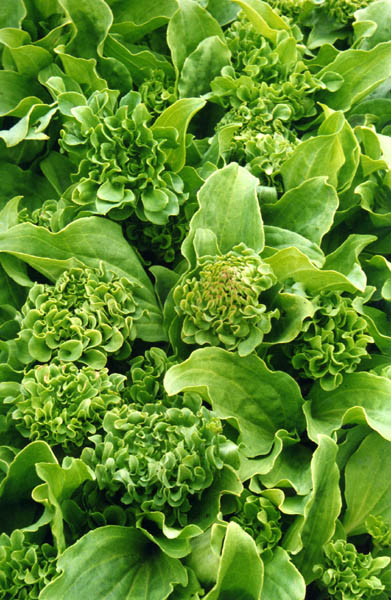
Perennial of the Plantaginaceae family, this curiosity form of the large common plantain has long been known in botanical gardens and collections of unusual plants. It is associated with the collector E. A. Bowles, who cultivated it in the early 20th century in his garden at Myddelton House, England, and who had a fondness for aberrant plant forms that he gathered in what he himself called his "lunatic asylum corner".
It is a stabilized floral fasciation in which the normally cylindrical and slender spike of the plantain transforms into a rosette of bracts and small greenish, curly, and imbricated leaves, resembling a miniature lettuce or a very elaborate green flower. Each transformed inflorescence thus forms a vegetal pompom of a tender to medium green, borne at the center or slightly above the broad and oval basal foliage, typical of the common plantain.
In its natural habitat, the common plantain blooms from June to October. In this cultivar, the transformed floral structures appear at the same period but do not produce viable seeds; propagation is done by clump division.
It is cultivated in ordinary, fresh to moist soil, in sun or partial shade. Its hardiness is good. It is more sought after for botanical collections and curiosity gardens than for classic rock gardens, but its unusual appearance and history make it a guaranteed conversation piece.